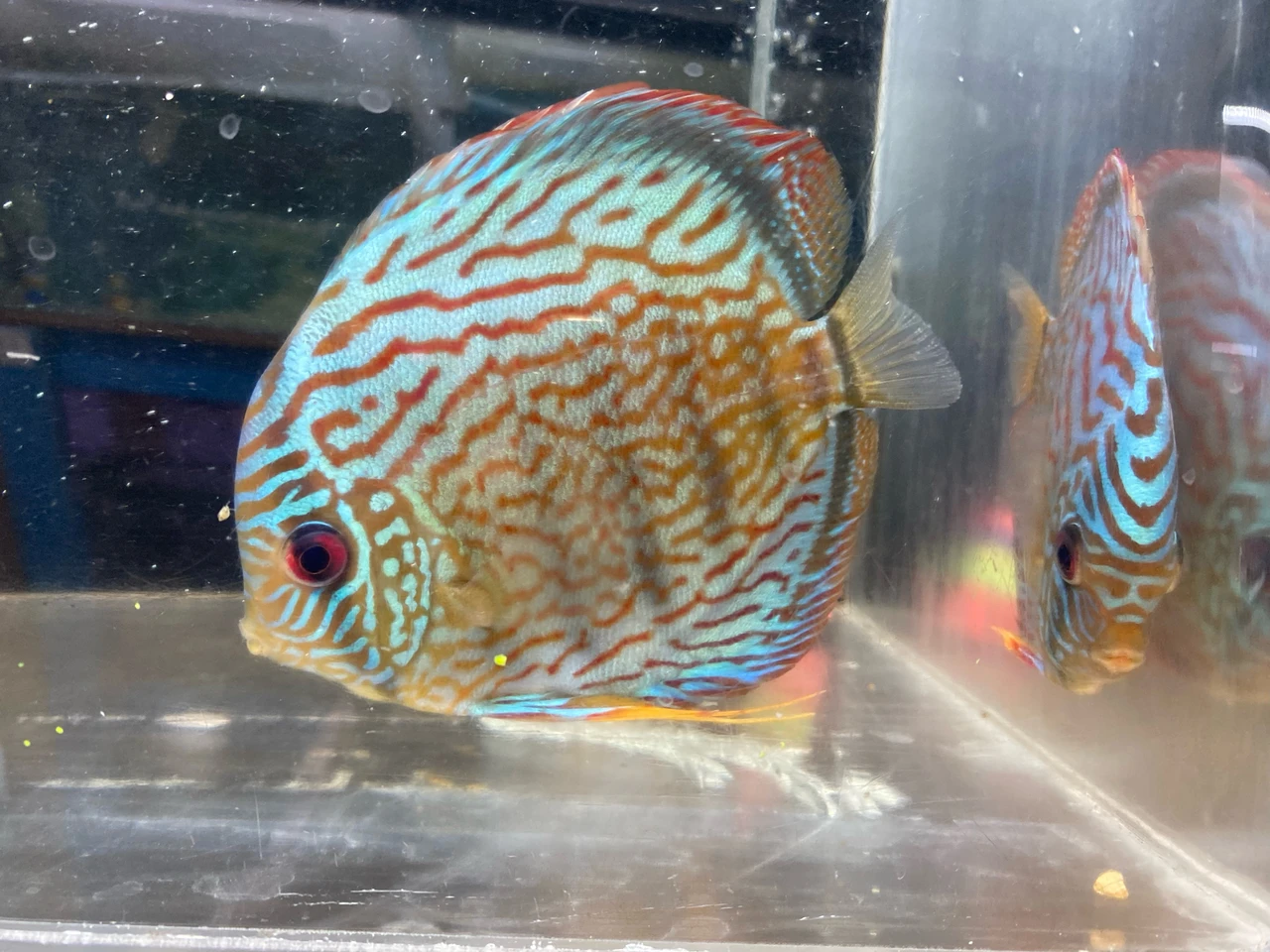
Symphysodon spp. — farm strain
Red Turquoise Discus
The classic. The strain most keepers start with and never stop loving. Here's how to keep them thriving.
Discus are deep-bodied, disc-shaped cichlids that demand pristine water and reward patience with color no other freshwater fish can match. Here's how to keep them, breed them, and tell one strain from the next.
Discus have a reputation, and it's earned. They're not hard because they're delicate specimens that keel over at the first mistake — they're hard because they demand consistency. Warm water, low organics, and steady chemistry, held for years, not weeks. Get it right and you get a fish that schools, pair-bonds, feeds its own fry off its skin, and grows into a dinner-plate-sized centerpiece with color that shifts by the week.
Discus Guides is built by aquarists for aquarists. Strain profiles that go past the pet-store tag, care fundamentals grounded in the actual demands of the hobby — not the sanitized version — breeding guides for one of the aquarium world's strangest parenting stories, and the community and sourcing knowledge that separates a farm-raised bargain from a stunted disappointment.
Detailed guides to every major discus strain — tank requirements, water params, temperament, tankmates, wild-type lineage, and farm-bred color forms.
Water chemistry, filtration, feeding routines, tank setup, social dynamics, disease recognition and treatment.
Pair conditioning, spawning behavior, the parental slime-feeding stage, strain selection, and why quality broodstock matters.
Discus history, Asian vs. German bloodlines, show culture, and the worldwide community that keeps chasing the perfect disc.
The classic. The strain most keepers start with and never stop loving. Here's how to keep them thriving.

The showpiece. Solid, saturated blue from nose to tail. One of the most sought-after solid-color strains.

The striking. Pale, almost white body with red eyes and scattered red spotting. Divisive and unmistakable.
They're not fragile, but they are demanding — the difficulty is almost entirely about consistency, not delicacy. Discus need warmer water than most tropical fish (82–86°F), frequent water changes, and a real commitment to water testing. Get those habits in place and discus are genuinely manageable; skip them and problems show up fast. See care fundamentals for the full breakdown.
Most farm-raised strains reach 6–8 inches (15–20 cm) in diameter as adults, though wild-caught fish tend to run a bit smaller, closer to 5–7 inches. Adult size and body depth both depend heavily on genetics, water quality, and diet during the juvenile growth stage.
A well-kept discus typically lives 10–15 years, sometimes longer with excellent water quality and diet. Lifespan tracks husbandry closely — stunted growth or chronic water-quality issues early in life usually shorten it.
55 gallons is the realistic floor for a small group of four to six juveniles, with 75–125 gallons recommended for a full-grown group of six adults. Tank height matters as much as footprint — discus are tall, deep-bodied fish and want at least 20 inches of vertical space. Full detail in tank setup.
Yes — discus are peaceful toward other species, with almost all aggression concerns being between discus themselves as they sort out a pecking order. Cardinal tetras, rummynose tetras, corydoras, and otocinclus are classic, compatible tankmates. See social dynamics for what to avoid.
Red Turquoise is the standard starting point — it's the most widely farmed, most affordable, and most forgiving of the color strains, and it teaches you the fundamentals before you invest in rarer stock. See the full variety library to compare strains.